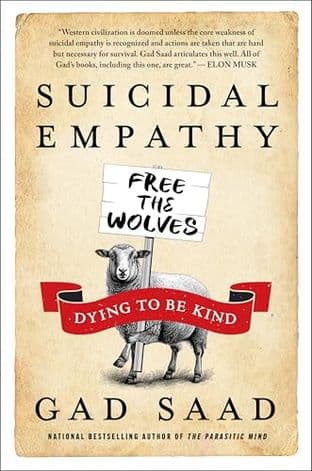
Is Suicidal Empathy Worth Reading?
by Gad Saad
Ada’s Score
Evolutionary behavioral scientist and podcast host Gad Saad presents a provocative argument that Western society's capacity for compassion has been weaponized against its own interests, creating what he terms 'suicidal empathy.' Drawing on evolutionary psychology, political philosophy, and cultural criticism, Saad contends that misguided compassion — unchecked by reason — leads societies toward self-destructive outcomes. The book is intentionally combative, designed to challenge progressive orthodoxies and spark debate about the limits of tolerance. Readers seeking a contrarian perspective on contemporary social policy will find it argued with conviction and characteristic Saad wit.
Ideas Spotlight“Saad argues with conviction and the central provocation lands, but the book leans on assertion where evidence should carry the weight.”
What Happens When Compassion Becomes a Weapon Against Itself
Gad Saad is a writer who thrives on the uncomfortable question, and Suicidal Empathy is his most provocative yet — a serious argument that unchecked empathy, stretched beyond its natural limits, can erode the very societies it means to protect. You don't have to agree with every word to find this book genuinely thought-provoking and worth the argument it starts. This is the kind of read that belongs in book clubs precisely because it will not let the room stay comfortable.
Ada Brief
AI reading intelligence“Saad argues with conviction and the central provocation lands, but the book leans on assertion where evidence should carry the weight.”
What Happens When Compassion Becomes a Weapon Against Itself
Gad Saad is a writer who thrives on the uncomfortable question, and Suicidal Empathy is his most provocative yet — a serious argument that unchecked empathy, stretched beyond its natural limits, can erode the very societies it means to protect. You don't have to agree with every word to find this book genuinely thought-provoking and worth the argument it starts. This is the kind of read that belongs in book clubs precisely because it will not let the room stay comfortable.
Suicidal Empathy Review
Saad argues with conviction and the central provocation lands, but the book leans on assertion where evidence should carry the weight.
Rating: 3.8 / 5
Ada’s reservations
Emotionally manipulative and thin on argument — Saad substitutes rhetorical heat for sustained proof and repeats his thesis past the midpoint. Readers wanting rigor over polemic won't find it.
Ada’s score reflects both strengths and reservations.
Book Details
- Language
- English
- ISBN-13
- 9780063446533
Get This Book
Affiliate linksISBN: 9780063446533
Disclosure: ReadAda earns a commission on purchases made through these links, at no extra cost to you.
Ada’s Score
3.8
Ada’s editorial score — not an aggregate of reader reviews.
Common Questions About Suicidal Empathy
- Is Suicidal Empathy worth reading?
- Saad argues with conviction and the central provocation lands, but the book leans on assertion where evidence should carry the weight. Ada rates it 3.8 out of 5.
- What are the main weaknesses of Suicidal Empathy?
- Emotionally manipulative and thin on argument — Saad substitutes rhetorical heat for sustained proof and repeats his thesis past the midpoint. Readers wanting rigor over polemic won't find it.
Ada also recommends
More from Psychology & Mental Health